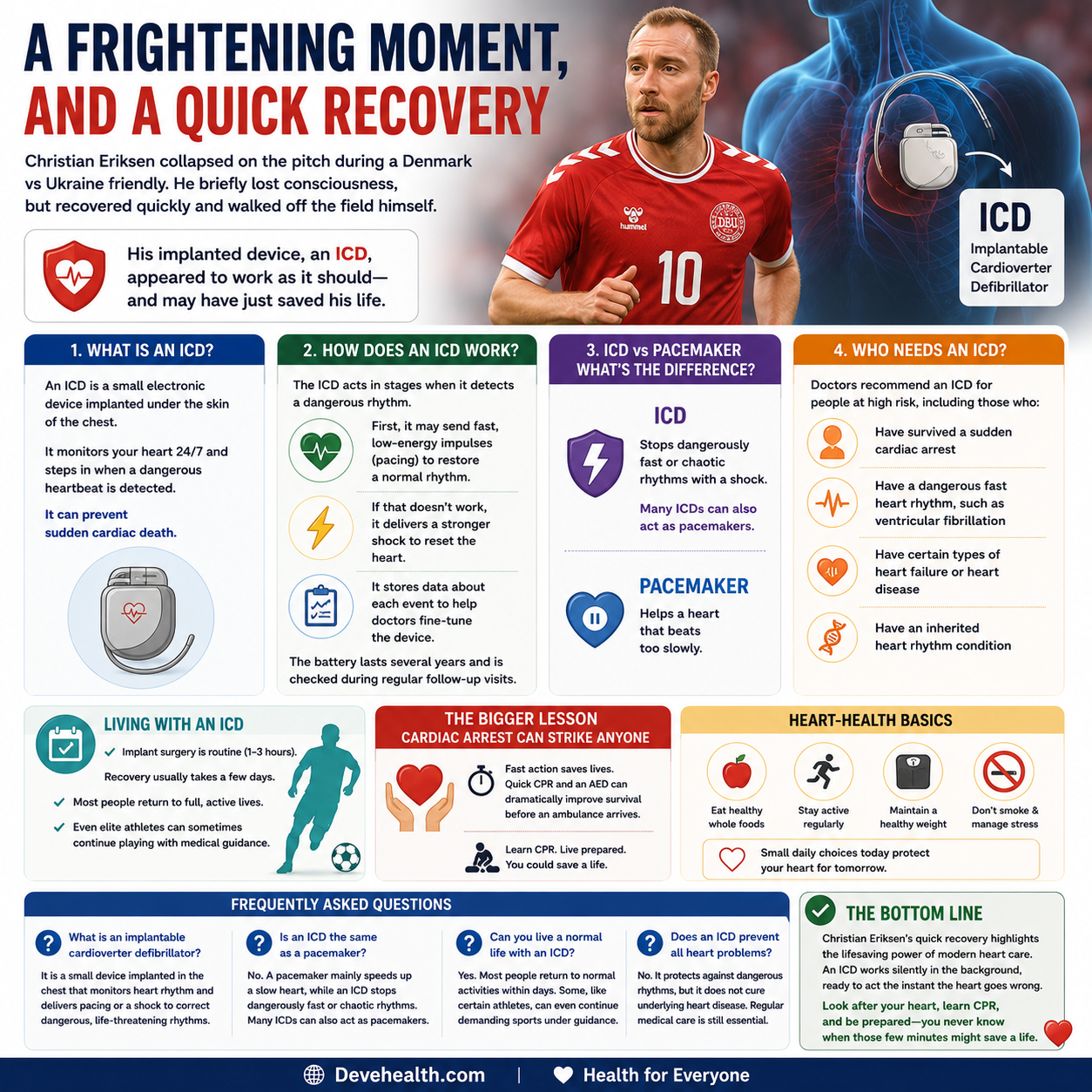
A Frightening Moment, and a Quick Recovery
Football fans held their breath again. During a friendly between Denmark and Ukraine, midfielder Christian Eriksen collapsed on the pitch and the match was abandoned.
This time, the scare was brief. Eriksen lost consciousness only for a moment, then recovered and walked off the field himself. His team doctor said the device implanted in his chest appeared to work as it should. That device is an implantable cardioverter defibrillator, and it may have just done its job.
What Happened to Eriksen
To understand the device, it helps to know his story. It is now well known in the football world.
In 2021, Eriksen suffered a cardiac arrest during a Euro match against Finland. Medics gave him CPR on the pitch and saved his life. Soon after, doctors fitted him with an implantable cardioverter defibrillator as a safeguard.
He then made a remarkable return to elite football, even scoring at Euro 2024. After his recent collapse, doctors reported he was conscious and undergoing tests to find the cause. His experience shows both the danger of heart rhythm problems and the value of the device protecting him.
What Is an Implantable Cardioverter Defibrillator?
An implantable cardioverter defibrillator, or ICD, is a small electronic device. Surgeons place it under the skin of the chest, usually near the collarbone.
Its job is simple but vital. It watches your heart rhythm 24 hours a day and steps in when that rhythm becomes dangerous. In doing so, it can prevent sudden cardiac death.
How Does an ICD Work?
The device is always on guard. It reacts in stages, depending on the problem.
Here is what an ICD does when it detects a dangerous rhythm:
- First, it may send fast, low-energy electrical impulses to nudge the heart back to normal. This is called pacing.
- If that fails, it delivers one or more stronger electric shocks to reset the heart.
- It also stores data about each event, which helps doctors fine-tune the device.
Most ICDs run on a battery that lasts several years. Doctors check the device and battery during regular follow-up visits.
ICD vs Pacemaker, What Is the Difference?
People often confuse the two devices. They look similar, but they do different jobs.
A pacemaker mainly helps a heart that beats too slowly. An ICD, by contrast, is designed to stop dangerously fast or chaotic rhythms with a shock. Many modern ICDs also include a pacemaker function, so they can do both.
Who Needs an ICD?
An ICD is not for everyone. Doctors recommend it for people at high risk of life-threatening heart rhythms.
Common candidates include people who:
- Have survived a sudden cardiac arrest
- Have a dangerous fast heart rhythm, such as ventricular fibrillation
- Have certain types of heart failure or heart disease
- Have an inherited heart rhythm condition
Living With an ICD
The implant procedure is fairly routine. It usually takes one to three hours under local anesthetic, so the person stays awake but feels no pain.
Recovery often takes only a few days. After that, many people return to full, active lives. As Eriksen’s career shows, even elite athletes can sometimes play on, though that decision is highly individual and made carefully with their doctors.
The Bigger Lesson, Cardiac Arrest Can Strike Anyone
Eriksen’s story carries a message for all of us. Sudden cardiac arrest can happen even to young, extremely fit people.
In those moments, fast action saves lives. Quick CPR and an automated external defibrillator (AED) can dramatically improve survival before an ambulance arrives. Learning basic CPR is one of the most valuable health skills you can have. Supporting that with a heart-healthy lifestyle matters too, and you can find simple ideas in our healthy food section.
Frequently Asked Questions
What is an implantable cardioverter defibrillator? It is a small device implanted in the chest that monitors heart rhythm and delivers pacing or a shock to correct dangerous, life-threatening rhythms.
Is an ICD the same as a pacemaker? No. A pacemaker mainly speeds up a slow heart, while an ICD stops dangerously fast or chaotic rhythms. Many ICDs can also act as pacemakers.
Can you live a normal life with an ICD? Yes. Most people return to normal activities within days. Some, like certain athletes, can even continue demanding sports under medical guidance.
Does an ICD prevent all heart problems? No. It protects against dangerous rhythms, but it does not cure underlying heart disease. Regular medical care is still essential.
The Bottom Line
Christian Eriksen’s latest collapse was frightening, but his quick recovery highlights how far heart care has come. An implantable cardioverter defibrillator works silently in the background, ready to act the instant the heart goes wrong.
For most people, the takeaway is twofold. Look after your heart with a healthy lifestyle, and learn CPR. You never know when those few minutes might save a life.