Making Sense of a Confusing Word
If you have ever heard someone described as having “stage 2” or “late-stage” cancer, you have encountered cancer staging. These terms are everywhere in health news and conversations, yet many people are unsure what they truly mean.
Cancer stages are simply the way doctors measure how serious a cancer is, based on its size and how far it has spread. Far from being just a label, the stage shapes major decisions about treatment and helps predict the likely outlook. Here is a clear, calm guide to what cancer stages mean, from stage 0 to stage 4, and the systems behind them.
What Does Cancer Staging Mean?
At its core, staging describes two things. How much cancer is in the body, and how far it has spread from where it started.
To work this out, doctors look at the size of the original tumor and whether it has reached nearby lymph nodes or distant organs. They gather this information through physical exams, imaging scans, blood tests, and biopsies. The stage is usually determined at the time of diagnosis, and it gives the care team a shared, precise picture of the disease.
Why Cancer Staging Matters
Staging is not just paperwork. It is one of the most important tools in cancer care, for several reasons.
First, it guides treatment, since the best approach for an early, localized cancer differs greatly from one that has spread. Second, it helps predict prognosis, the likely course and outlook of the disease. Third, it gives doctors a common language to communicate clearly with each other and with patients. It can also determine whether someone is eligible for certain clinical trials.
How Doctors Figure Out the Stage
Staging is not guesswork. Doctors piece it together from several different tests, building a detailed map of the cancer.
The process often combines:
- A physical examination, to check for lumps or other signs
- Imaging scans, such as X-rays, CT, MRI, or PET scans, to see the tumor and any spread
- Blood tests, which can reveal markers linked to certain cancers
- A biopsy, where a small sample of tissue is examined under a microscope
Together, these results tell the team how large the tumor is and whether it has reached lymph nodes or distant organs. The more complete the picture, the more accurate the stage, and the better the treatment plan that follows.
The Number Stages, 0 to 4
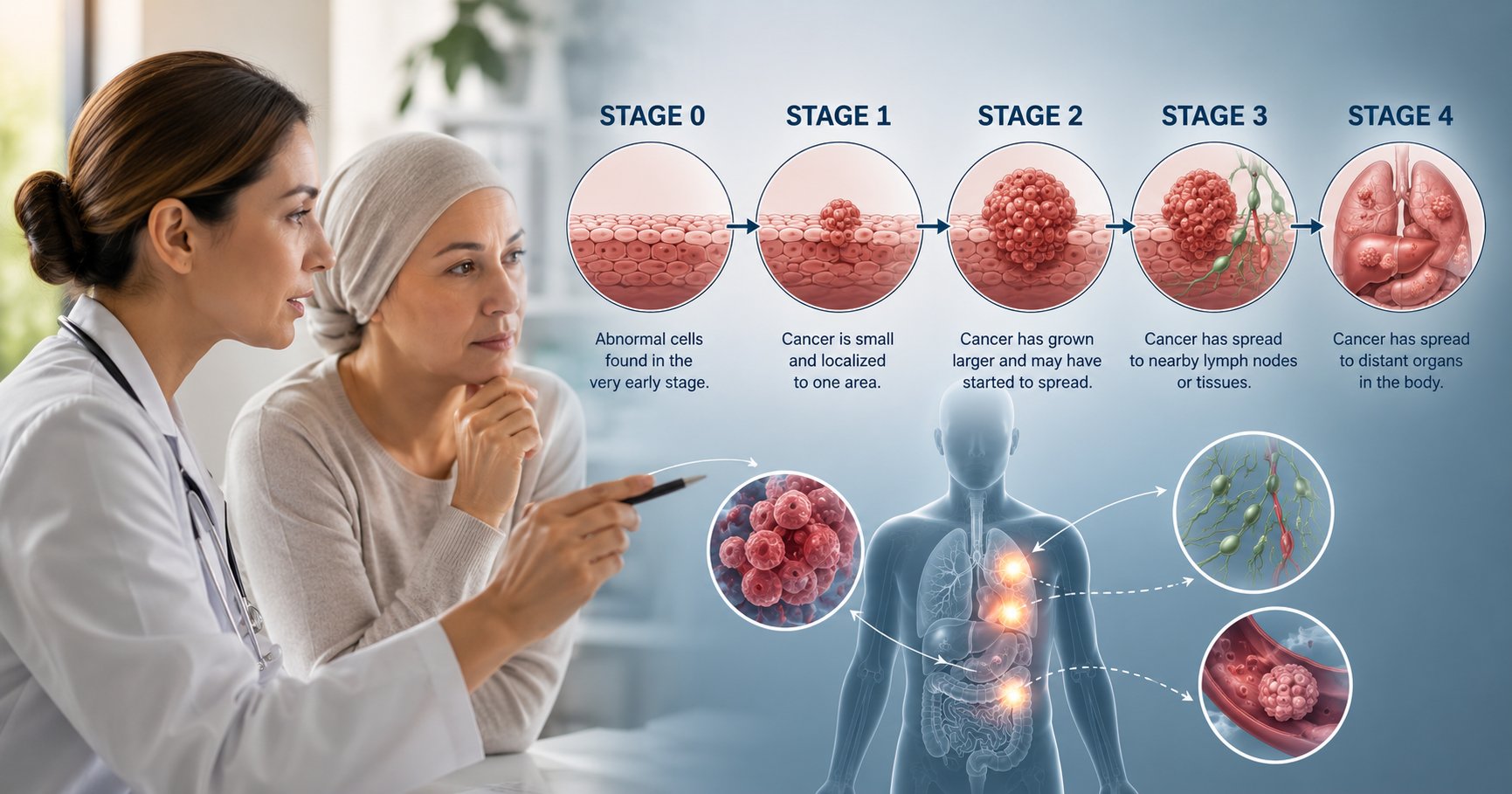
For most cancers, the overall stage is given as a number from 0 to 4, often written in Roman numerals as I, II, III, and IV. As a general rule, the higher the number, the more the cancer has grown or spread. Stages are sometimes subdivided further with letters like A, B, and C.
Stage 0
This is the earliest stage, also called carcinoma in situ. Abnormal cells are present but have not spread, and they are not yet considered true invasive cancer. Caught here, the condition is highly treatable, though these cells could become cancerous over time.
Stage 1
At stage 1, there is a small cancer that is localized to where it began. It has not spread to nearby lymph nodes or other parts of the body. This early, contained stage usually offers the most treatment options.
Stage 2
By stage 2, the tumor is larger, or it has grown more deeply into nearby tissue. It may still be limited to the area where it started, with little or no spread to lymph nodes.
Stage 3
At stage 3, the cancer is more advanced. It has typically spread to nearby, or regional, lymph nodes, though it has not yet reached distant organs.
Stage 4
Stage 4 is the most advanced stage. Here the cancer has spread to distant parts of the body, a process called metastasis. This is often described as metastatic or advanced cancer, and it usually calls for more intensive or different kinds of treatment.
The TNM System Behind the Numbers
So how do doctors arrive at that single number? For most solid tumors, they use a detailed system called TNM. The letters stand for tumor, node, and metastasis.
Here is what each part measures:
- T (tumor) describes the size of the main tumor and how far it has grown into nearby tissue.
- N (node) describes whether and how much the cancer has spread to nearby lymph nodes.
- M (metastasis) describes whether the cancer has spread to distant parts of the body.
A number is added after each letter to show the extent, such as T1 or N0. Doctors then combine these three pieces into the overall stage from 0 to 4. It is worth noting that the TNM system is used mainly for solid tumors, like breast or colon cancer. Blood cancers such as leukemia and lymphoma use different systems.
Stage Versus Grade, a Key Difference
One of the most common points of confusion is the difference between stage and grade. They sound similar, but they describe different things.
Stage, as we have seen, is about how much cancer there is and how far it has spread. Grade is about how the cancer cells look under a microscope compared with normal cells. A higher grade means the cells look more abnormal, which often signals a faster-growing, more aggressive cancer. Doctors use both stage and grade together to build a fuller picture and plan the most effective treatment.
Other Words Doctors Use
Beyond numbers, you may hear simpler descriptive terms for how far a cancer has spread. These are often used in statistics and general explanations.
The most common are localized, meaning the cancer is only where it started, regional, meaning it has reached nearby tissue or lymph nodes, and distant, meaning it has spread to faraway organs. This simpler approach, used by cancer registries, has the advantage of staying consistent over time, which makes it useful for tracking survival statistics across many years.
Does Your Stage Change Over Time?
This surprises many people. The stage assigned at diagnosis generally stays the same, even if the cancer later grows or shrinks.
For example, a cancer first diagnosed as stage 1 is still referred to by that original stage, even if it spreads afterward. To reflect a change after treatment, doctors may add a small letter, such as an “r” for restaging. Staging done before treatment is called clinical staging, while staging based on findings during surgery is called pathologic staging. This consistency helps doctors track how a specific cancer behaves over time.
Does an Earlier Stage Mean a Better Outlook?
In general, yes. Cancers found at an earlier stage tend to be more treatable and are associated with better survival than those found later.
But it is important not to read too much into the number alone. Prognosis depends on many factors, including the type of cancer, its grade, its location, and a person’s overall health. Two people with the same stage can have very different journeys. So while staging is a powerful guide, it is not a fixed verdict. Your oncologist is always the best source for understanding what a stage means in your particular situation.
The Best Outcome Starts Before Staging
Here is an empowering thought. The earlier a cancer is found, the lower its stage tends to be, and the better the outlook. That is the whole point of screening.
You can also lower your risk of developing many cancers in the first place. Protective habits include eating a fiber-rich diet with plenty of vegetables and fruit, which you can explore in our healthy food section, staying physically active, as we cover in our guide on strength training and why it matters, keeping a healthy weight, not smoking, and limiting alcohol. Combined with recommended screenings, these steps give you the best chance of catching any problem early.
Frequently Asked Questions
What do cancer stages mean? They describe how much cancer is in the body and how far it has spread, usually on a scale from stage 0 to stage 4. A higher number generally means more spread.
What is the difference between stage and grade? Stage describes how far the cancer has spread. Grade describes how abnormal the cancer cells look under a microscope, which hints at how aggressive it may be.
What does stage 4 cancer mean? Stage 4 means the cancer has spread to distant parts of the body, known as metastasis. It is the most advanced stage and often requires more intensive treatment.
What is the TNM system? It is a staging system based on the tumor size (T), spread to lymph nodes (N), and spread to distant sites (M). Doctors combine these to assign an overall stage.
Does an early stage mean the cancer is curable? Earlier stages are generally more treatable and have better outcomes, but prognosis depends on many factors. Your doctor can explain what your stage means for you.
The Bottom Line
Cancer staging is the language doctors use to describe how serious a cancer is and how far it has spread. From stage 0, where abnormal cells have not yet invaded, to stage 4, where cancer has reached distant organs, the stage guides treatment and helps predict the outlook.
Understanding these terms can make a frightening diagnosis feel a little less overwhelming. And the most hopeful message is this. Through healthy habits and timely screening, you can improve your odds of catching cancer early, when the stage is lowest and the chances are best.