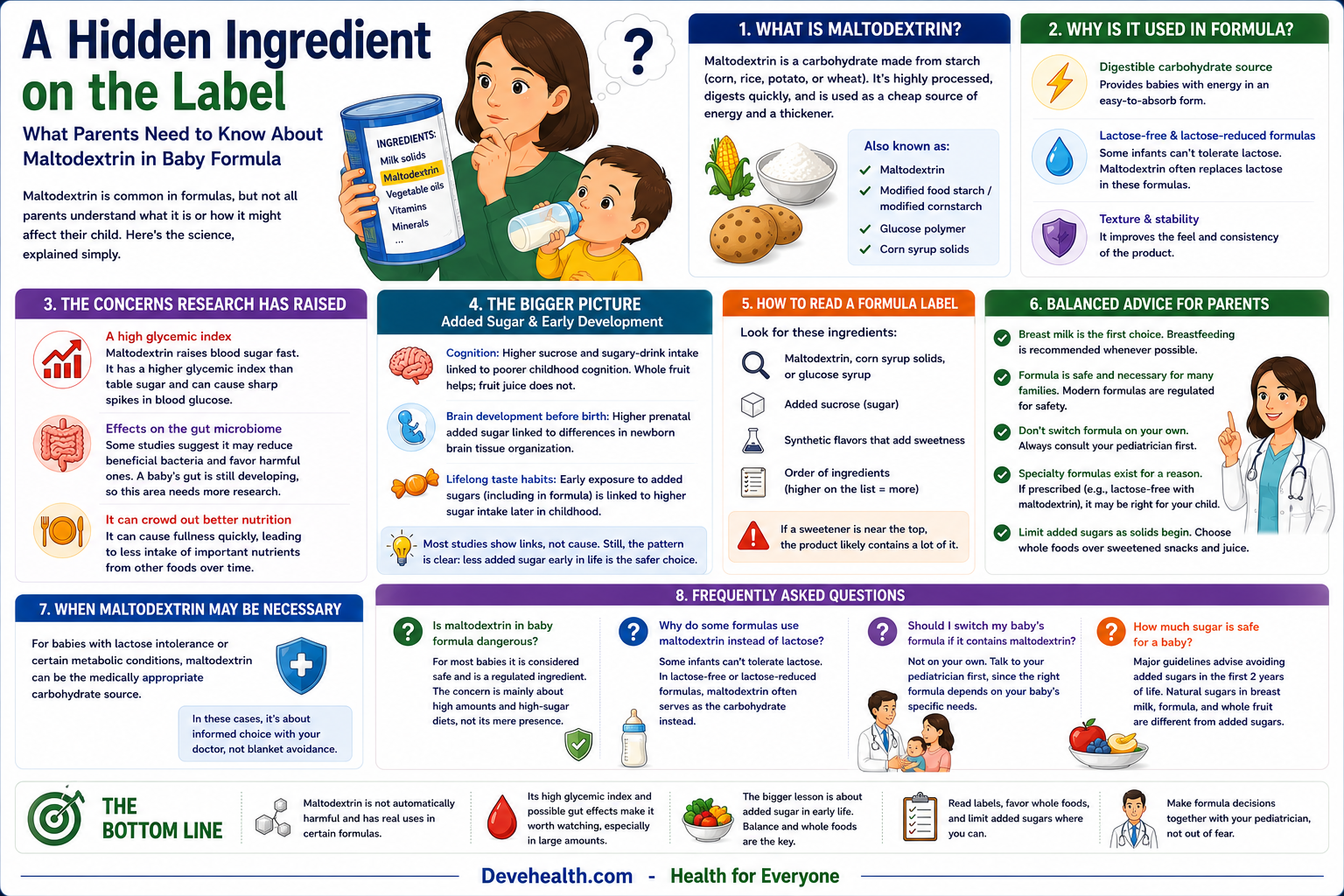
A Hidden Ingredient on the Label
Every parent wants the best for their child. So when it comes to milk, you want a formula that supports healthy growth and brain development.
Yet many parents never read the full ingredient list. One ingredient that shows up often is maltodextrin. It rarely makes headlines, but it is worth understanding. This guide explains what maltodextrin is, why it is used, and what research actually says about it.
What Is Maltodextrin?
Maltodextrin is a carbohydrate made from starch. Manufacturers usually produce it from corn, rice, potato, or wheat. Despite the source, it is a highly processed ingredient.
Chemically, it is a chain of glucose units. The body digests and absorbs it quickly. That is why food makers value it as a cheap, easy source of carbohydrate and as a thickener.
It can appear on labels under several names, including:
- Maltodextrin
- Modified food starch or modified cornstarch
- Glucose polymer
- Corn syrup solids
Why Is Maltodextrin Used in Baby Formula?
Maltodextrin is not added to formula at random. It serves real purposes, and that matters for a fair picture.
The main reasons include:
- A digestible carbohydrate source. It gives babies energy in an easy-to-absorb form.
- Lactose-free and lactose-reduced formulas. Some infants cannot tolerate lactose. In these formulas, maltodextrin often replaces lactose as the carbohydrate.
- Texture and stability. It improves the feel and consistency of the product.
So in some specialty formulas, maltodextrin plays a genuine role. The concern is less about its mere presence and more about how much, and in which products.
The Concerns Research Has Raised
Research has flagged a few issues with maltodextrin, especially in large amounts. Here is what the evidence shows.
A high glycemic index
Maltodextrin raises blood sugar fast. In fact, it has a higher glycemic index than ordinary table sugar. That means it can cause sharp spikes in blood glucose.
For most healthy children, an occasional spike is not dangerous. But a diet built on high-glycemic carbs is not ideal for steady energy or long-term metabolic health.
Effects on the gut microbiome
The gut is home to trillions of helpful bacteria. Some research suggests maltodextrin may disturb this balance.
Studies indicate it may reduce beneficial bacteria and favor harmful ones. A baby’s gut is still developing, so this area deserves attention. Still, the science is evolving, and findings are not yet final.
It can crowd out better nutrition
Maltodextrin and added sugars can make a child feel full quickly. As a result, a baby may take in less of the nutrients they need from other foods. Over time, this can affect a balanced diet during the crucial growth years. You can read more about how nutrition shapes growth in our guide on stunting in children.
The Bigger Picture, Added Sugar and Early Development
Maltodextrin is part of a wider concern about sugar early in life. This is where the strongest evidence sits, and it is worth knowing.
The early years shape lifelong health. Research links high sugar intake in infancy and pregnancy to several outcomes:
- Cognition. A large study found that higher sucrose and sugary-drink intake was associated with poorer childhood cognition. Notably, whole fruit was linked to better scores, while fruit juice was not.
- Brain development before birth. One study connected higher prenatal added sugar to differences in newborn brain tissue organization.
- Lifelong taste habits. Early exposure to added sugars, including through infant formula, is linked to higher sugar intake later in childhood.
It is important to read these carefully. Most are observational studies, so they show links, not firm proof of cause. Even so, the pattern points in a consistent direction. Limiting added sugar early is a sensible goal.
How to Read a Formula Label
You do not need to be a nutritionist to read a label well. A few habits help a lot.
When you check a formula or toddler milk, look for:
- Maltodextrin, corn syrup solids, or glucose syrup
- Added sucrose, also listed simply as sugar
- Synthetic flavors that make the product sweeter
- The order of ingredients, since items near the top are present in larger amounts
If a sweetener sits high on the list, the product likely contains a lot of it.
Balanced Advice for Parents
Here is the most important part. None of this means you should panic or suddenly change your baby’s formula.
Keep these points in mind:
- Breast milk is the recommended first choice. Health authorities advise breastfeeding where possible, especially in the early months.
- Formula is a safe and valid option. For many families, formula is necessary, and modern formulas are regulated for safety.
- Do not switch formula on your own. Always talk to a pediatrician before changing your baby’s formula.
- Specialty formulas exist for a reason. If a doctor prescribes a lactose-free formula with maltodextrin, it may be the right choice for your child.
- Limit added sugars as solids begin. Once your baby starts solid foods, favor whole foods over sweetened products and juice.
When Maltodextrin Is Actually Necessary
Sometimes maltodextrin is the better option, not the worse one. Babies with lactose intolerance or certain metabolic conditions may need a lactose-free formula.
In those cases, a maltodextrin-based carbohydrate can be medically appropriate. So the goal is informed choice with your doctor, not blanket avoidance.
Frequently Asked Questions
Is maltodextrin in baby formula dangerous? For most babies it is considered safe and is a regulated ingredient. The concern is mainly about high amounts and high-sugar diets, not its mere presence.
Why do some formulas use maltodextrin instead of lactose? Some infants cannot tolerate lactose. In lactose-free or lactose-reduced formulas, maltodextrin often serves as the carbohydrate instead.
Should I switch my baby’s formula if it contains maltodextrin? Not on your own. Talk to your pediatrician first, since the right formula depends on your baby’s specific needs.
How much sugar is safe for a baby? Major guidelines advise avoiding added sugars in the first two years of life. Natural sugars in breast milk, formula, and whole fruit are different from added sugars.
The Bottom Line
Maltodextrin in baby formula is not automatically harmful, and it has real uses in certain products. Still, its high glycemic index and possible gut effects make it worth watching, especially in large amounts.
The bigger lesson is about added sugar in early life. Read labels, favor whole foods as your child grows, and limit added sugars where you can. Above all, make formula decisions together with your pediatrician, not out of fear.