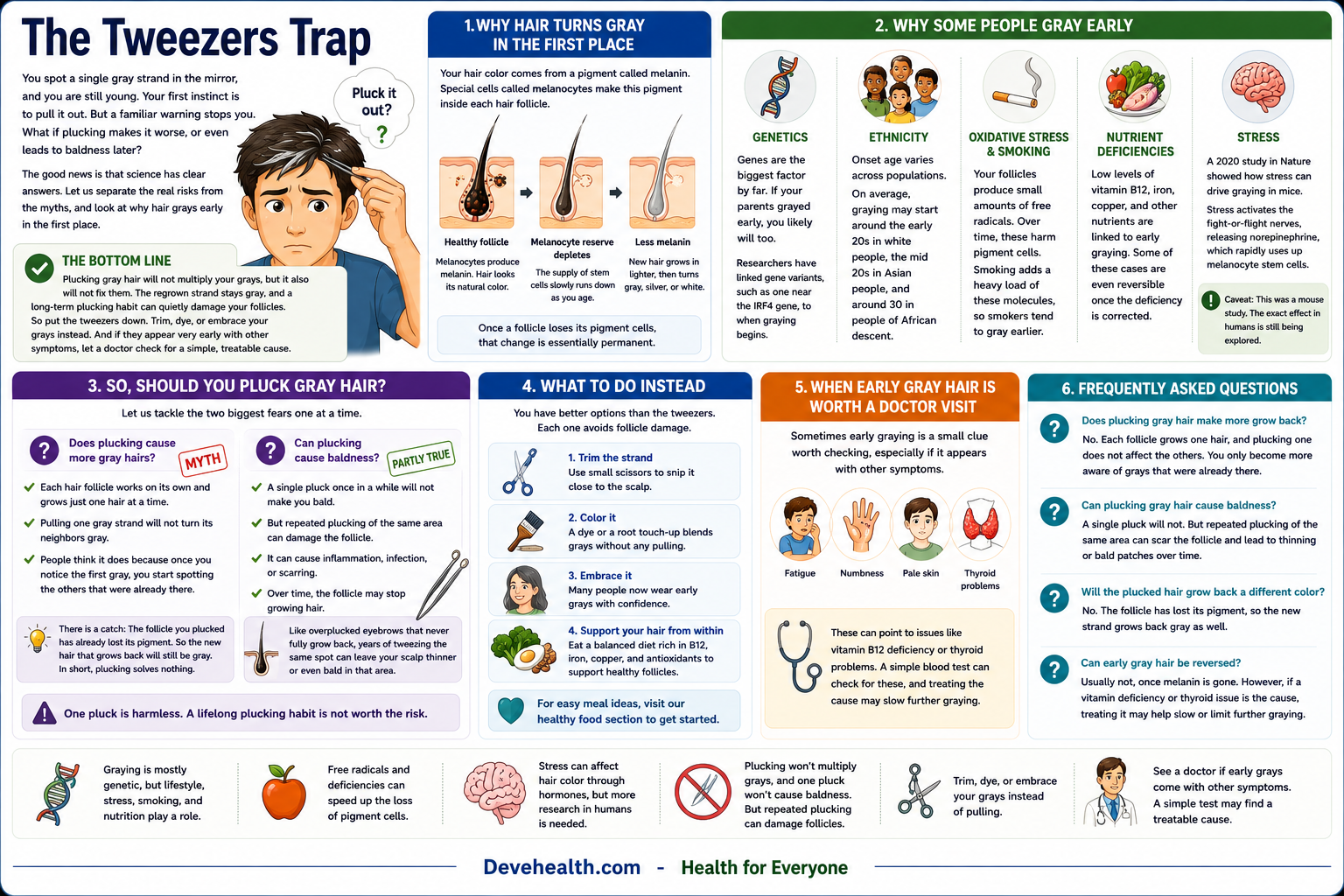
The Tweezers Trap
You spot a single gray strand in the mirror, and you are still young. Your first instinct is to pull it out. But a familiar warning stops you. What if plucking makes it worse, or even leads to baldness later?
This worry is extremely common. The good news is that science has clear answers. Let us separate the real risks from the myths, and look at why hair grays early in the first place.
Why Hair Turns Gray in the First Place
Your hair color comes from a pigment called melanin. Special cells called melanocytes make this pigment inside each hair follicle. These cells rely on a reserve of melanocyte stem cells that sit at the base of the follicle.
As you age, that reserve slowly runs down. The follicle makes less melanin, so new hair grows in lighter. Eventually it turns gray, silver, or white. Once a follicle loses its pigment cells, that change is essentially permanent.
Why Some People Gray Early
Graying before your time is called premature hair graying. A 2025 review in the International Journal of Dermatology describes it as a mix of genetic, biological, and environmental factors. Here are the main drivers.
Genetics
Genes are the biggest factor by far. If your parents grayed early, you likely will too. Researchers have even linked specific gene variants, such as one near the IRF4 gene, to when graying begins.
Ethnicity
Onset age varies across populations. On average, graying may start around the early 20s in white people, the mid 20s in Asian people, and around 30 in people of African descent.
Oxidative stress and smoking
Your follicles produce small amounts of damaging molecules called free radicals. Over time, these harm the pigment cells. Smoking adds a heavy load of these molecules, which is why smokers tend to gray earlier.
Nutrient deficiencies
Diet matters more than people think. Low levels of vitamin B12, iron, copper, and certain other nutrients are linked to early graying. Some of these cases are even reversible once the deficiency is corrected.
Stress
Stress is not just an old wives’ tale. A landmark 2020 study in Nature, led by Harvard researchers, showed how stress can drive graying in mice. Acute stress fired up the fight-or-flight nerves, which flooded follicles with norepinephrine. That chemical rapidly used up the melanocyte stem cells.
Keep one caveat in mind. This was a mouse study, so the exact effect in humans is still being explored. Still, it gives a real biological reason behind a very old belief.
So, Should You Pluck Gray Hair?
Now for the question that started it all. Let us tackle the two biggest fears one at a time.
Does plucking cause more gray hairs?
No. This is a myth. Each hair follicle works on its own and grows just one hair at a time.
So pulling one gray strand will not turn its neighbors gray. The reason people think it does is simple. Once you notice the first gray, you start spotting the others that were already there.
There is a catch, though. The follicle you plucked has already lost its pigment. So the new hair that grows back will still be gray. In short, plucking solves nothing.
Can plucking cause baldness?
Here the popular warning holds a kernel of truth. Pulling out one gray hair once in a while will not make you bald. But repeated plucking is a different story.
Each pluck tugs and traumatizes the follicle. Do that to the same spot over and over, and you can trigger inflammation, infection, or scarring. Dermatologists warn that repeated trauma can damage a follicle until it stops growing hair at all.
Think of eyebrows that were overplucked for years. Often they never fully grow back. The same logic applies to your scalp. Years of tweezing the same area can leave it thinner over time, much like the pulling damage seen in traction alopecia.
So the honest answer is this. One pluck is harmless. A lifelong plucking habit is not worth the risk.
What to Do Instead
You have better options than the tweezers. Each one avoids follicle damage.
First, simply trim the strand. Use small scissors to snip it close to the scalp. Second, color it if it bothers you. A dye or a root touch-up blends grays without any pulling. Third, consider leaving it alone. Many people now wear early grays with confidence.
You can also support your hair from the inside. A balanced diet rich in B12, iron, and antioxidants helps your follicles work well. For easy meal ideas, browse our healthy food section to get started.
When Early Gray Hair Is Worth a Doctor Visit
Sometimes early graying is a small clue worth checking. This is especially true if it appears with other symptoms.
See a doctor if your gray hair comes alongside fatigue, numbness, or pale skin. These can point to a vitamin B12 deficiency. Thyroid problems can also play a role. A simple blood test can check for these, and treating the cause may slow further graying.
Frequently Asked Questions
Does plucking gray hair make more grow back? No. Each follicle grows one hair, and plucking one does not affect the others. You only become more aware of grays that were already there.
Can plucking gray hair cause baldness? A single pluck will not. But repeated plucking of the same area can scar the follicle and lead to thinning or bald patches over time.
Will the plucked hair grow back a different color? No. The follicle has lost its pigment, so the new strand grows back gray as well.
Can early gray hair be reversed? Usually not, once melanin is gone. However, if a vitamin deficiency or thyroid issue is the cause, treating it may help slow or limit further graying.
The Bottom Line
Plucking gray hair will not multiply your grays, but it also will not fix them. The regrown strand stays gray, and a long-term plucking habit can quietly damage your follicles.
So put the tweezers down. Trim, dye, or embrace your grays instead. And if they appear very early with other symptoms, let a doctor check for a simple, treatable cause.