The Most Overlooked Part of Your Shoe
Take a quick look down at your shoes right now. Do your toes have room to spread out comfortably, or are they being gently funneled into a narrow point? For most people, it is the latter, and they have never even noticed.
The toe box, the front section of a shoe where your toes sit, is one of the most overlooked features in all of footwear. Yet its width quietly influences everything from your comfort to your long-term foot health. As the idea of foot-shaped shoes gains popularity, more people are discovering that toe box width matters far more than they ever realized. Here is why this simple detail deserves your attention.
What Exactly Is the Toe Box?
Before going further, let us define the term clearly, since it is the heart of this whole topic. It is simpler than it sounds.
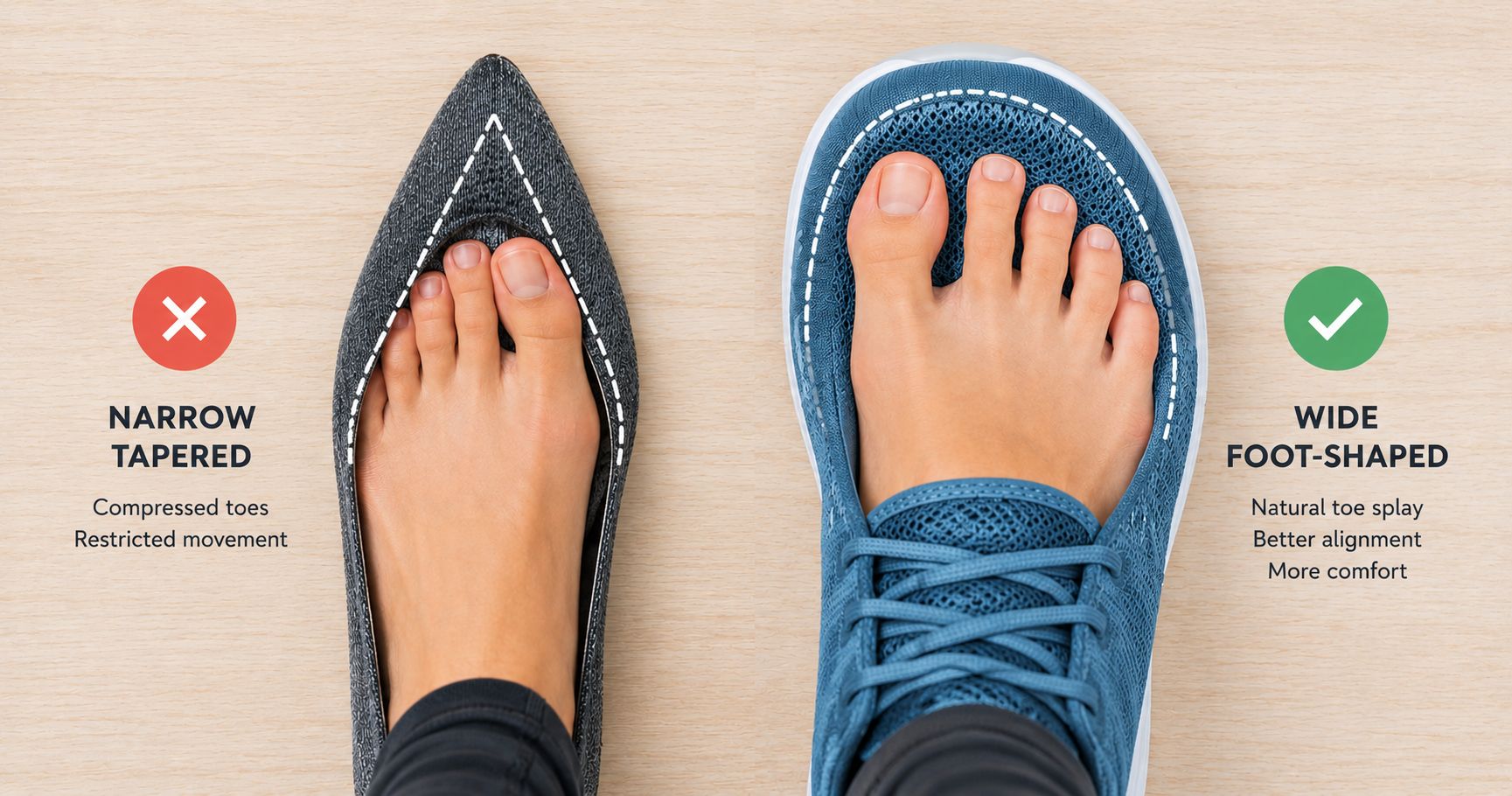
The toe box is the front part of the shoe that surrounds and covers your toes. A wide toe box offers plenty of horizontal space, allowing your toes to lie flat and spread apart naturally, much as they would if you were barefoot. A narrow or tapered toe box, by contrast, squeezes the toes together toward a point. This tapered shape is extremely common, because many conventional shoes are designed for a sleek, fashionable look rather than the actual shape of a human foot.
Your Feet Are Widest at the Toes
Here is the key fact that makes this whole topic click into place. It is something most shoe designs quietly ignore.
A healthy, natural foot is actually widest across the toes, not the middle. Your toes are meant to splay outward, especially when you bear weight on them. Yet most shoes are narrowest exactly where your foot should be widest. As one podiatrist explains, the forefoot naturally splays with weight bearing, and this widening is important to aid in balance, shock absorption, and forward propulsion. When a shoe prevents that natural movement, it works against the way your foot is designed to function.
How a Narrow Toe Box Affects Your Feet
So what actually happens when your toes are squeezed together day after day? Over time, the effects can go well beyond simple discomfort. This is where the health stakes become clear.
When the toe box is tapered, it can gradually push the big toe inward and compress the bones of the forefoot. According to podiatrists, this pressure may contribute to issues such as bunions, neuromas, hammertoes, and painful calluses. Population studies also suggest that narrow toe boxes may play a role in the development of bunions, known medically as hallux valgus. These are not minor annoyances. Some of these changes to the structure of your foot can become permanent over years of wear.
The Bunion Connection
Of all these issues, bunions deserve special attention, because they are so common and so closely tied to footwear. Many people wonder whether their shoes caused them.
A bunion is a bony bump that forms at the base of the big toe when the toe drifts inward. While genetics play a major role in who develops them, footwear matters too. A toe box that is too narrow compresses the big toe joint sideways, which can accelerate that inward drift and cause pain. This is why podiatrists so often recommend a wide, foot-shaped toe box for people with bunions or a tendency toward them. The extra room takes pressure off the joint, making everyday walking far more comfortable.
The Benefits of Giving Your Toes Room
It is not only about avoiding problems. A roomy toe box offers active benefits for nearly everyone, even people who do not consider themselves to have wide feet. The advantages are surprisingly wide-ranging.
When your toes have space to spread, several good things happen:
- Better balance and stability, since splayed toes widen your base of support
- Reduced pressure points, meaning fewer blisters, calluses, and pinched toes
- Improved circulation, because tight shoes that constrict the toes can restrict blood flow
- Less foot fatigue, as your toes are free to move naturally throughout the day
These benefits matter for everyone, but they are especially valuable for older adults seeking better balance, and for people who spend long hours on their feet.
Especially Important for Some People
While ample toe space helps everyone, for certain groups it moves from helpful to genuinely important. These are the people who should pay the closest attention.
People with diabetes, arthritis, or nerve issues like neuropathy often need extra room to prevent pressure sores and complications, which is why podiatrists frequently recommend wide toe box shoes for them. Children are another key group. Their growing feet are especially vulnerable, and restrictive footwear during development can contribute to lifelong foot problems. For anyone in these categories, prioritizing toe box width is a simple but meaningful step. We explore the wider issue of how footwear shapes your body in our guide on how the wrong shoes affect your whole body.
How to Choose a Shoe With the Right Toe Box
Knowing all this, how do you actually find shoes that respect your toes? A few simple checks make all the difference when you shop. It is easier than you might think.
Look for a toe box shaped like an actual foot, wider at the toes, rather than tapering to a point. A good test is to make sure you can wiggle all your toes freely, with a little space at the very front. Some people even trace their bare foot on paper, then place their shoe on top to compare the shapes. One important caution stands out. Avoid the common mistake of simply buying a longer size to gain toe room, since that makes the heel slip. Instead, focus on adequate width in the forefoot while keeping a secure fit through the heel and midfoot.
Wide Toe Box Is Not the Same as a Wide Shoe
One point causes a lot of confusion when people start shopping, so it is worth clearing up. A wide toe box and a wide-fit shoe are not always the same thing.
A traditional wide-fit shoe is usually just a scaled-up version of the standard shape, made wider all over, including the heel and midfoot. It may still taper to a point at the toes. A true wide or foot-shaped toe box, on the other hand, is specifically broad at the front to allow toe splay, while often keeping a snug, secure fit through the heel. This distinction matters because what your toes need is room at the front, not necessarily a looser shoe overall. When shopping, look closely at the actual shape of the toe area, not just the width label on the box.
A Note on Making the Switch
If you decide to move toward roomier, foot-shaped shoes, a little patience helps. Your feet have likely spent years adapting to narrow shoes. Easing in protects you from doing too much too soon.
If your new shoes also have a very flat or minimal sole, give your feet time to adjust gradually, rather than switching all at once. The muscles and tendons in your feet need time to adapt to working in a more natural way. Many people find it helps to wear the new shoes for short periods at first, slowly building up. Pairing this with general foot strength helps too, and gentle daily movement like the routine in our guide on the Japanese walking workout keeps your feet active and resilient.
Listen to Your Feet
As with all things footwear, comfort and fit are deeply personal. Your feet will tell you a great deal if you pay attention. This connects to a bigger habit of foot awareness.
If your toes feel cramped, or you notice the warning signs of poorly fitting shoes, it may be time to rethink your footwear. Many of these signals overlap with the broader signs your shoes are hurting your feet. It also pays to replace footwear once it is worn out, a topic we cover in our guide on how often you should replace your shoes, and to choose well-fitted shoes for activity, as in our guide on the right shoe size for sports. If you have ongoing toe pain, bunions, or a foot condition, a podiatrist can offer personalized advice.
The Bottom Line
Toe box width may be the most underrated feature in any shoe, yet it shapes your comfort, your balance, and the long-term health of your feet. Your toes are meant to spread and move freely, and a narrow, pointed toe box works against that natural design, contributing to issues like bunions over time.
The good news is that choosing better is simple. Look for a foot-shaped toe box that lets your toes splay, prioritize width over just length, and give your feet room to do what they were built to do. It is a small detail with a surprisingly big impact, and your feet will thank you for it.