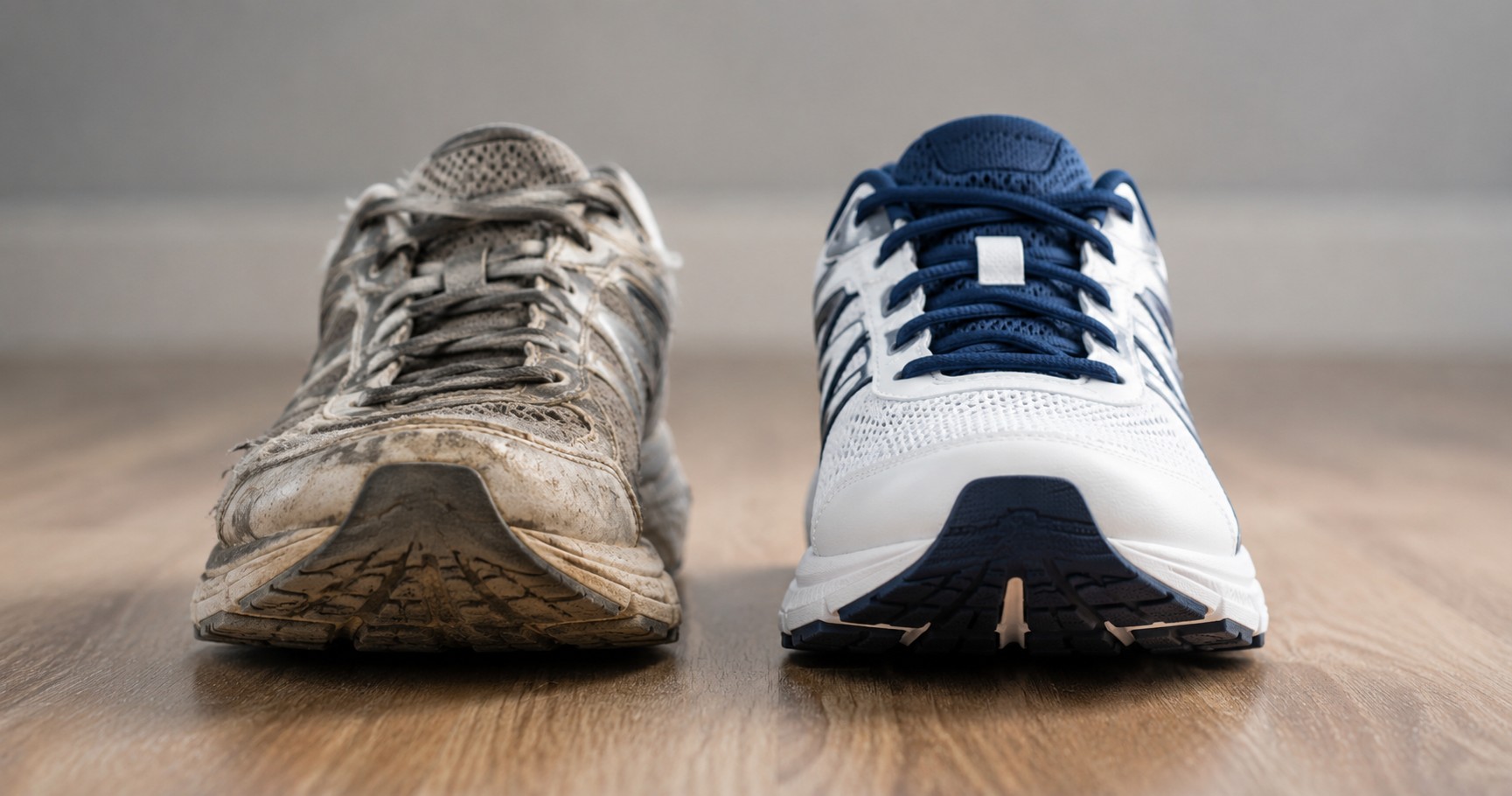
The Shoes That Look Fine but Are Not
Be honest for a moment. When was the last time you replaced your everyday shoes? For many of us, the answer is far too long ago, usually defended with the classic line, they still look fine.
Here lies the most important truth about shoes. They tend to wear out from the inside long before they show it on the outside. By the time the cushioning is gone, your shoes may still look perfectly fine while quietly putting your feet and joints at risk. So how often should you really replace your shoes? The answer comes down to a simple rule of thumb, a few telltale signs, and an understanding of why it matters so much.
The Simple Rule, 300 to 500 Miles
If you want one easy benchmark, this is the one experts return to again and again. It is measured in distance, not just time.
The widely accepted guideline is to replace your shoes every 300 to 500 miles, which is roughly 500 to 800 kilometers. That is the range where the midsole cushioning in most shoes loses its resilience and stops absorbing shock as well as it once did. This rule was developed for running shoes, but the same principle applies to walking shoes and everyday sneakers, since the miles you log on casual walks count too. It is the cushioning, not the look, that determines a shoe’s true lifespan.
Prefer to Think in Months?
Counting miles is not for everyone, and that is perfectly fine. You can translate that same guideline into a simple timeframe instead.
For most people who are moderately active, that 300 to 500 mile range works out to roughly every 6 to 12 months, according to podiatrists. If you run often or are on your feet all day, you will reach the lower end much sooner. If you only wear a particular pair occasionally, they may last toward the upper end, though the materials still break down with age. A useful rule for occasional runners is to replace shoes around every six months regardless of mileage, since foam degrades over time even with light use.
Your Job and Lifestyle Change the Math
Not everyone wears shoes the same way, so the timeline shifts depending on your daily routine. This is especially true if you spend long hours on your feet.
Consider someone who works in retail or a factory and hits around 10,000 steps a day. That is roughly 5 miles daily, which adds up fast. As one podiatrist notes, for jobs that require a lot of walking, changing your shoes every 3 to 4 months is recommended. Other factors speed up wear too. Heavier individuals generate more force with each step, rough pavement breaks shoes down faster than soft surfaces, and lightweight or minimalist shoes wear out sooner than cushioned ones.
Different Shoes, Different Lifespans
It is worth knowing that not every type of shoe wears out at the same rate. The 300 to 500 mile guideline is a general benchmark, but the design of a shoe shifts where it falls in that range.
Minimalist and lightweight racing shoes use thinner soles and less foam, so they tend to wear out faster, sometimes in as few as 250 to 300 miles. Traditional and maximum-cushioned trainers usually last closer to the 500 mile mark, though their soft, high foam can still compress with heavy use. Trail shoes face rough terrain that wears the tread and grip quickly, even when the thicker materials look intact. And everyday casual sneakers, while lower impact, still break down gradually as the foam compresses over months of use.
The practical takeaway is simple. Match your expectations to the kind of shoe you own, and lean toward the lower end of the range if you are heavier, very active, or running on hard surfaces.
The Warning Signs Your Shoes Are Done
Mileage is a helpful guide, but your shoes and body give clear signals too. Learning to read them means you never have to guess. Watch for these common signs that it is time for a new pair:
- Flattened cushioning. Press the midsole with your thumb. If it feels hard, flat, or lifeless instead of soft and springy, the cushioning is gone.
- Worn or uneven tread. Smooth patches or one shoe more worn than the other signals the shoe is breaking down.
- Visible creases. Deep wrinkles along the side of the midsole foam mean it has lost its bounce.
- New aches and pains. Fresh soreness in your feet, shins, knees, hips, or back after activity is a classic clue.
That last sign is one of the most telling. If a normal walk or run suddenly leaves you sore in ways it usually would not, your shoes are often to blame.
Two Quick At-Home Tests
Beyond a visual check, podiatrists use a couple of simple hands-on tests you can do yourself. They take just seconds and reveal a lot.
The first is the bend test. Hold the shoe and try to bend it. A supportive shoe should flex mainly at the ball of the foot. If it folds easily in half through the middle, the midsole support is gone. The second is the heel counter test. The heel counter is the stiff cup at the back of the shoe that holds your heel. Press it with your thumb, and if it collapses easily, the shoe has lost its stability. Many people are genuinely surprised by these tests, because their shoes still look fine on the outside.
Why Worn-Out Shoes Are a Real Risk
This is not just about comfort or appearances. Continuing to wear shoes past their prime carries a genuine risk of injury, which is the whole reason this matters.
When the midsole foam compresses and stops absorbing shock, that impact gets transferred straight to your muscles and joints instead. Over time, this added stress raises the risk of common overuse injuries. These include shin splints, plantar fasciitis, and knee, hip, and back pain. Worn shoes can also alter your gait and increase the chance of slipping once the tread wears smooth.
This connects to a bigger picture. Worn-out shoes are really just one version of poorly supportive footwear, and as we explain in our guide on how the wrong shoes affect your whole body, that lost support travels right up the chain. Many of the signs your shoes are hurting your feet, such as fresh blisters or aching arches, also appear as a pair breaks down. In short, a fresh pair is not a luxury. It is one of the simplest forms of injury prevention you can practice.
How to Make Your Shoes Last Longer
Before you toss every aging pair, know that a few smart habits can genuinely extend their lifespan. You can push toward the higher end of that mileage window with a little care.
The single best trick is to rotate between two pairs. Alternating shoes gives the midsole foam time to decompress and recover between wears, which slows the breakdown. It also helps to use your athletic shoes only for their intended activity, keeping an older pair for errands and casual use. If you are active, choosing well-fitted athletic shoes in the first place matters too, as we cover in our guide on the right shoe size for sports. Letting shoes air out and dry fully, rather than leaving them damp, protects the materials too. When you do retire a pair from active duty, you can often demote them to light tasks like gardening before recycling them.
Pairing fresh shoes with healthy movement makes the biggest difference of all. Gentle daily activity, such as the routine in our guide on the Japanese walking workout, keeps your feet and joints resilient, and strengthening the muscles that support you, as covered in our guide on strength training and why it matters, helps your body handle every step.
A Quick Word on Insoles and Inserts
One part of the shoe that people almost always forget is the insole. If you use supportive inserts, they have a shelf life of their own.
Over-the-counter insoles and orthotic inserts also lose their cushioning and support over time, often within about six months of regular use. Many people keep using the same worn inserts for years, long after the support has flattened. So when you assess your shoes, check your insoles too. If they look compressed or no longer feel supportive, replacing them can refresh an otherwise decent pair of shoes.
How to Track It Without the Guesswork
If remembering all this feels like a chore, there are easy ways to stay on top of it. A little tracking removes the guesswork entirely.
The simplest low-tech method is to write the purchase date inside the shoe with a marker, so you always know how old the pair is. If you use a running or fitness app, many let you log miles to each pair of shoes and will alert you as you approach the replacement range. Even a quick note in your phone works. These small habits make it easy to catch worn-out shoes before they catch up with your feet.
The Bottom Line
So, how often should you replace your shoes? As a general rule, aim for every 300 to 500 miles, or roughly every 6 to 12 months for most people, and sooner if you are very active or on your feet all day.
Most importantly, do not rely on how your shoes look. Trust how they feel and what your body tells you. Flattened cushioning, uneven tread, and new aches are all signs it is time. Replacing worn-out shoes is one of the cheapest and easiest ways to protect your feet and joints from injury, so give your feet the fresh support they deserve.