The Silent Problem With a Visible Clue
High cholesterol is often called a silent killer, and for good reason. It rarely produces obvious symptoms, which means many people carry dangerously high levels for years without knowing. By the time it makes itself known, it may already have done damage to the heart and arteries.
But in some cases, the body does leave a clue, and it can show up in a surprising spot. One of the lesser-known signs of high cholesterol appears not in the chest, but in the legs, specifically around the back of the ankle.
The Clue Hiding at the Back of Your Ankle
The medical name for this clue is tendon xanthoma, a build-up of cholesterol deposits inside a tendon. It usually appears as small, slow-growing lumps under the skin. While xanthomas can form in different places, the Achilles tendon, the thick band of tissue connecting your calf muscle to your heel bone, is the most common site.
The earliest characteristic is not always an obvious lump, but a gradual thickening of the Achilles tendon itself. Because this change is slow and painless, it is easy to overlook, which is exactly what makes it worth knowing about.
What the Research Found
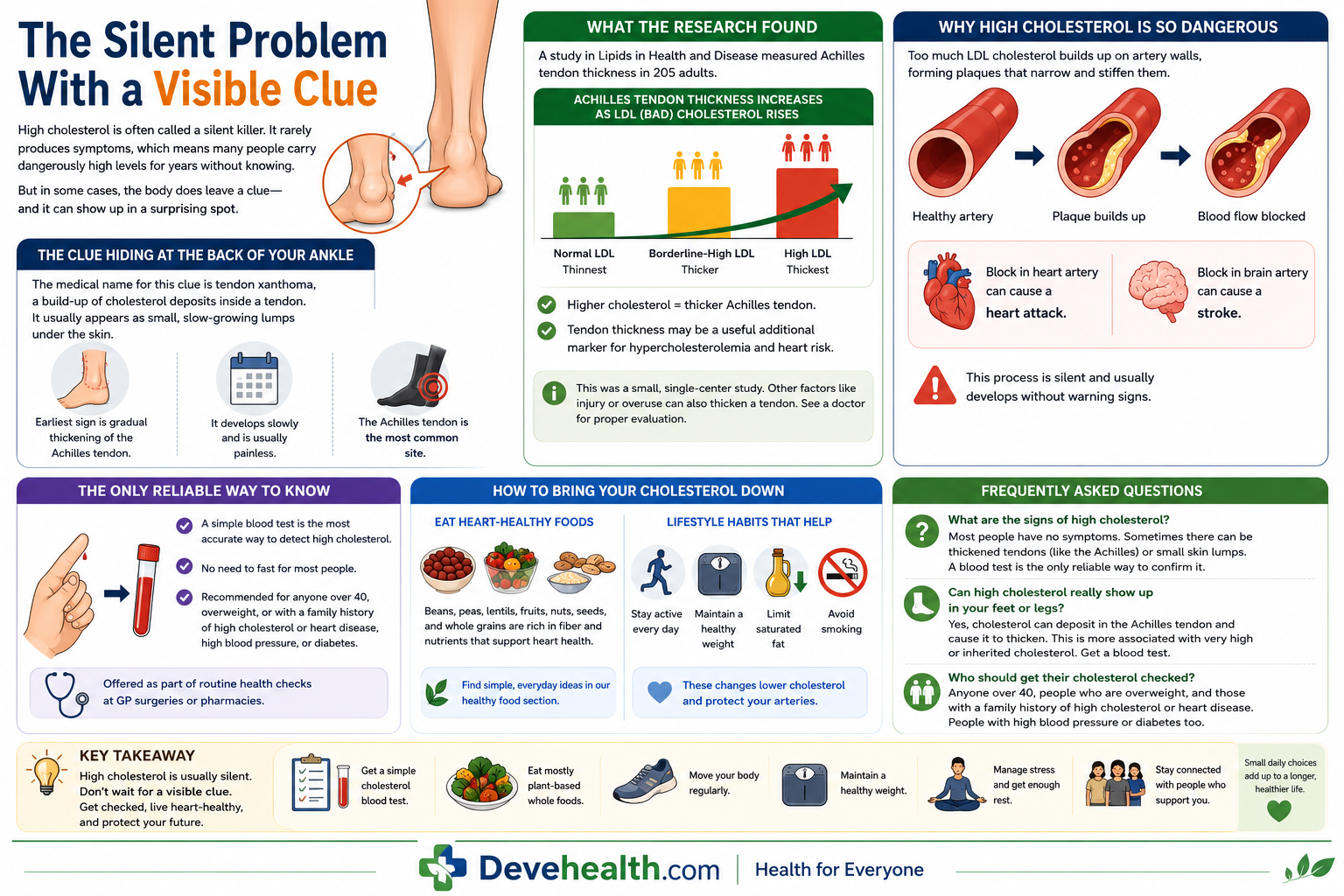
The link between a thickened Achilles tendon and high cholesterol is not just anecdotal. A study published in the journal Lipids in Health and Disease set out to measure it directly. Researchers enrolled 205 participants aged 18 to 75 and sorted them into three groups based on their LDL levels: a normal group, a borderline-high group, and a group with hypercholesterolemia, the condition of abnormally high cholesterol, which can be inherited.
Using a standardized digital radiography method to measure Achilles tendon thickness, the team found a clear pattern. Participants with higher cholesterol had significantly thicker Achilles tendons than those with normal levels, and tendon thickness rose along with LDL, the so-called bad cholesterol. The researchers concluded that Achilles tendon thickness could serve as a useful additional marker to help assess hypercholesterolemia and cardiovascular risk.
It is worth keeping perspective, though. The authors themselves noted the study was small and conducted at a single center, so the finding is a helpful signal rather than a standalone diagnostic test. A thickened tendon can have other causes too, such as injury or overuse. The takeaway is not to self-diagnose from your ankle, but to treat an unexplained, persistent thickening as one more reason to get your cholesterol checked.
Why High Cholesterol Is So Dangerous
Your body actually needs some cholesterol to build healthy cells. The problem begins when there is too much of the wrong kind. When LDL cholesterol builds up on the inner walls of your arteries, it can form plaques that narrow and stiffen them, a process called atherosclerosis.
Over time, this restricts blood flow. If a plaque blocks an artery feeding the heart, the result can be a heart attack. If it blocks blood flow to the brain, it can cause a stroke. Crucially, this process usually develops quietly, without warning signs, which is why waiting to feel unwell is a poor strategy.
The Only Reliable Way to Know
Since you cannot feel high cholesterol, the most accurate way to detect it is a simple blood test. According to the UK’s National Health Service, a cholesterol test can be done with a finger-prick or a blood sample sent to a lab, and most people do not need to fast beforehand. Those over 40 may be offered one as part of a routine health check at a GP surgery or pharmacy.
Regular testing is especially sensible if you are over 40, are overweight, or have a family history of high cholesterol or heart disease. A doctor may also suggest a test if you have related conditions such as high blood pressure or diabetes.
How to Bring Your Cholesterol Down
If a test shows your levels are high, the first line of action is usually lifestyle change, starting with what you eat. Foods that support healthier cholesterol include beans, peas, and lentils, along with fruits, nuts, seeds, and whole grains, all of which are rich in the kind of fiber and nutrients that benefit your heart. If you want ideas for building these into your meals, browse our healthy food section for simple, everyday options.
Beyond diet, the familiar habits still do the heavy lifting: stay physically active, maintain a healthy weight, limit saturated fat, and avoid smoking. These changes not only lower cholesterol but also protect the arteries more broadly.
Frequently Asked Questions
What are the signs of high cholesterol? In most people there are no symptoms at all, which is why it is called a silent condition. In some cases, physical signs of high cholesterol can appear, such as cholesterol deposits in tendons (most often a thickened Achilles tendon) or small lumps under the skin. A blood test remains the only reliable way to confirm it.
Can high cholesterol really show up in your feet or legs? Yes, though it is not common. Cholesterol can deposit in the Achilles tendon and cause it to thicken. This is more associated with very high or inherited cholesterol, and should prompt a blood test rather than serve as a diagnosis on its own.
Who should get their cholesterol checked? Anyone over 40, people who are overweight, and those with a family history of high cholesterol or heart disease. People with high blood pressure or diabetes should also be tested.
The Bottom Line
The most important thing to understand about the signs of high cholesterol is that, most of the time, there are none you can see or feel. A quietly thickening Achilles tendon is a rare and useful exception, a reminder that the condition can leave subtle traces. But you should never wait for a visible clue. A simple blood test, paired with a heart-friendly diet and active lifestyle, remains the surest way to catch high cholesterol early and protect yourself from a future heart attack or stroke.