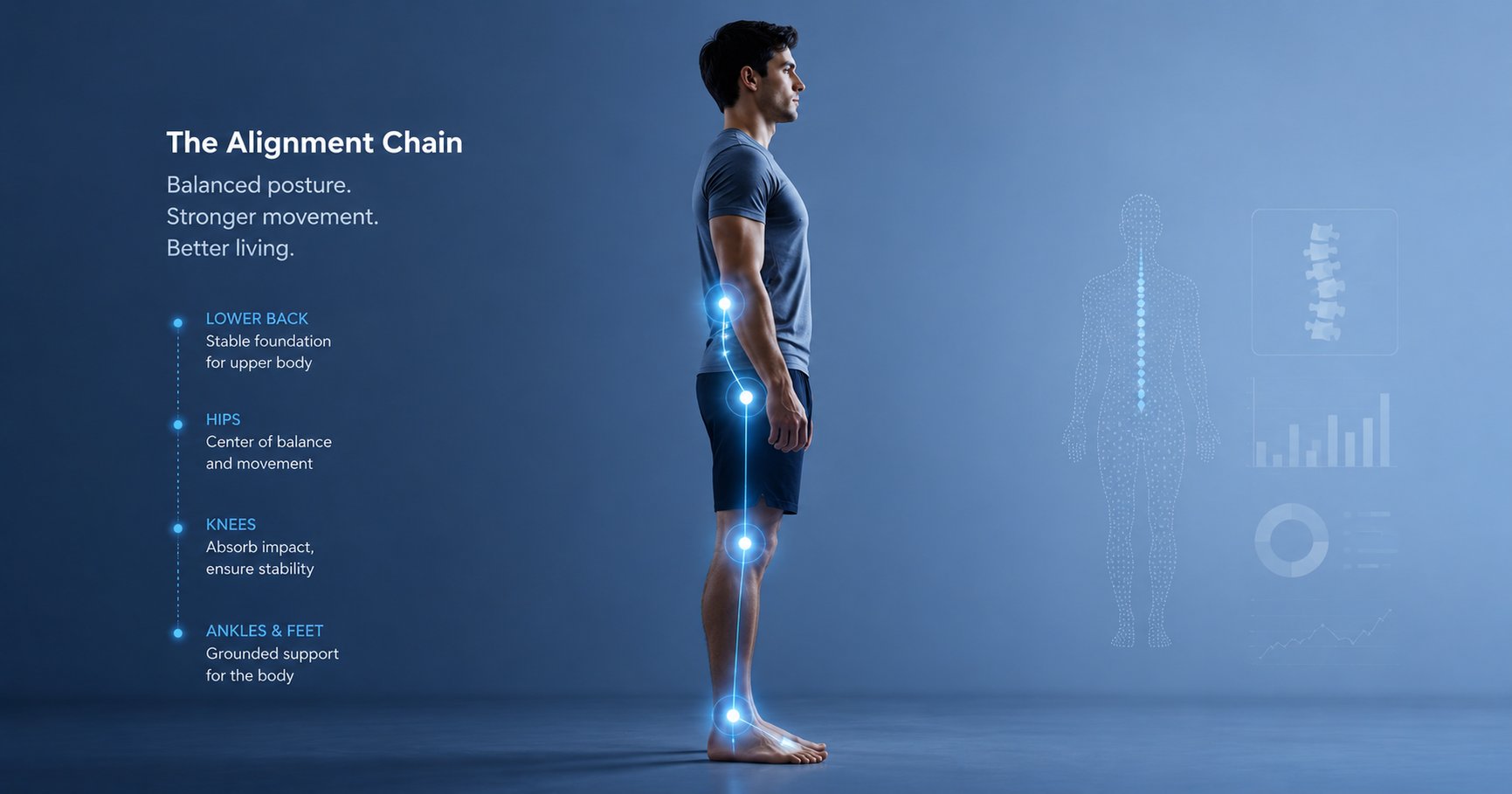
That nagging pain in your knee, hip, or lower back is easy to blame on age, a hard workout, or simply sleeping awkwardly. But there is a surprisingly common culprit that most people overlook entirely. Your shoes.
It turns out the wrong shoes do far more than give you sore feet or a blister. They can quietly set off a chain reaction of discomfort that travels all the way up your body. As one podiatrist put it, your feet are the foundation of your body. When that foundation is off, everything built on top of it is affected. Understanding how this works can change the way you think about every pair of shoes you own.
The Kinetic Chain, Why Foot Pain Becomes Whole-Body Pain
To understand how shoes affect your back, you first need to know about something called the kinetic chain. It is the key to this entire topic.
Your body is a connected system. The bones, joints, and muscles work together like links in a chain that runs from your feet up through your ankles, knees, hips, and into your spine. Experts describe how this lower-body kinetic chain travels from the feet all the way up to the spine, so that any misalignment in one area sets off a chain reaction in the others. Since every step you take starts at your feet, your footwear is essentially the first link in that chain. Get it wrong, and the effects ripple upward.
How It Starts, Trouble at Your Feet
The damage usually begins right where you would expect, in the feet themselves. This is the first and most obvious stage.
Shoes that fit poorly or lack the right support can directly cause or worsen a range of foot problems. These commonly include:
Bunions and hammertoes
Corns and calluses
Plantar fasciitis, a common cause of heel pain
Ingrown toenails
These issues are uncomfortable on their own. But the real trouble begins when your body starts trying to compensate for them, which is where the rest of your body gets involved.
Moving Up, Your Knees and Hips
Once your feet are out of alignment, the next links in the chain feel the strain. Your knees and hips often bear the brunt of it.
A major factor here is something called overpronation, which is when the arch collapses and the foot rolls excessively inward. When this happens, the foot rolls inward, followed by the leg, which can lead to inner knee pain and hip pain. In other words, a problem that starts at your arch forces your knee and hip joints out of their natural alignment. Over time, this added stress can contribute to issues like knee arthritis and hip strain. Poor arch support, in particular, changes your walking mechanics in ways your joints were never designed to handle.
Reaching the Top, Your Back and Posture
The chain reaction does not stop at your hips. It continues all the way up to your spine, which is why so many people are surprised to learn their back pain may start at their feet.
When your feet and hips are misaligned, your pelvis can tilt, and your spine is forced to curve to compensate. Your feet are also meant to act as natural shock absorbers. When shoes fail to support them properly, that shock is sent up through the body instead. As spine specialists explain, wearing the wrong footwear can disrupt your body’s natural alignment and contribute to chronic back pain over time. The muscles of your back then have to work harder just to keep you upright, leading to fatigue and pain.
The Usual Suspects, Shoes That Cause the Most Trouble
So which shoes are the biggest offenders? While the wrong fit can come in any style, a few common types are especially likely to throw your body out of balance.
High heels are perhaps the most notorious. By elevating the heel, they pitch your body weight forward and force a major change in your posture, redistributing pressure in ways that strain the whole chain. Flat, completely unsupportive shoes sit at the other extreme, offering no arch support and leaving your feet to fatigue. Worn-out shoes are another hidden problem, since once the cushioning and structure break down, they stop protecting you. Finally, shoes that simply do not fit, whether too tight, too loose, or the wrong shape for your foot, set the whole process in motion.
How to Spot the Warning Signs
How can you tell if your shoes are the problem? Your body, and your shoes themselves, often give clear clues if you know where to look.
Pay attention to recurring foot pain, tired or achy feet at the end of the day, or unexplained knee, hip, or back pain that flares up with certain shoes. Your shoes tell a story too. Podiatrists often examine wear patterns on the soles, because uneven wear on the inside of the shoe and heel can reveal overpronation. If one shoe is far more worn than the other, or the tread is breaking down unevenly, your footwear may be working against you.
Choosing Shoes That Support Your Whole Body
The good news is that the right shoes can protect your entire kinetic chain, not just your feet. Choosing well is one of the simplest investments in your long-term comfort.
Look for shoes that genuinely fit your foot, with enough room in the toe area and a shape that matches your foot. Seek a balance of support and cushioning suited to your needs, replace shoes once they are worn out, and choose footwear appropriate for your activity.
A few concrete features help when you shop. Try shoes on later in the day, when your feet are at their largest, and leave about a thumb’s width of space beyond your longest toe. Check that the shoe bends at the ball of the foot, where your foot naturally flexes, rather than in the middle. Make sure the heel holds your foot securely without slipping, and walk around to feel for any pinching or pressure before you buy. Small checks like these prevent most fit problems before they start. If you are active, the right athletic footwear matters even more, a point we explore in our guide on choosing the right shoe size for sports. Strengthening the muscles that support your posture helps too, as we cover in our guide on strength training and why it matters, and keeping a healthy weight, which you can support by watching for hidden sugar in everyday foods, reduces the load on every joint in the chain. Building movement into your day, such as the routine in our guide on the Japanese walking workout, keeps the whole system strong. And if persistent pain continues despite better shoes, it is worth understanding that even general foot care, including avoiding common warm-weather missteps covered in our look at whether jogging in a jacket helps, fits into a bigger picture of moving well.
Do Not Forget Your Indoor Hours
One detail that surprises many people is how much time the feet spend out of shoes entirely. Your footwear away from the street matters just as much.
Most of us spend hours each day indoors, often barefoot or in flat, unsupportive house slippers. For people who already struggle with arch support, all that unsupported time can quietly add to foot fatigue and strain the same chain. This does not mean you must wear stiff shoes at home. But if you have ongoing foot or joint pain, paying attention to what you wear indoors, and giving your arches some support, can make a meaningful difference over the course of a day.
When to See a Professional
Sometimes better shoes are not quite enough, and that is worth knowing. If pain persists, professional help can make a real difference.
A podiatrist can assess your foot mechanics and gait, identify problems like overpronation, and recommend solutions. For some people, custom orthotic inserts help by correcting imbalances and improving alignment, which in turn reduces the strain that travels up the kinetic chain. If you have ongoing foot, knee, hip, or back pain that you suspect is linked to your footwear, do not just push through it. A proper evaluation can get to the root of the problem.
The Bottom Line
It is easy to think of foot pain as just foot pain, but your body is far more connected than that. The wrong shoes can set off a chain reaction that travels from your feet up through your knees, hips, and all the way to your spine, quietly fueling pain you might never connect to your footwear.
The reassuring news is how much power you have to change it. By choosing shoes that fit well, offer the right support, and suit your activity, and by replacing them when they wear out, you protect your whole body from the ground up. Your feet really are your foundation, so it is worth giving them the support they deserve.